

There is a phrase many neurodivergent people have heard, directly or indirectly:
Something is wrong with you.
Maybe it was said by a teacher who thought you were not trying hard enough. A parent who did not understand your behavior. A colleague who considered your communication style unusual. Or, sometimes, by your own inner voice after years of being told that the way you think, feel, communicate, or experience the world is a problem.
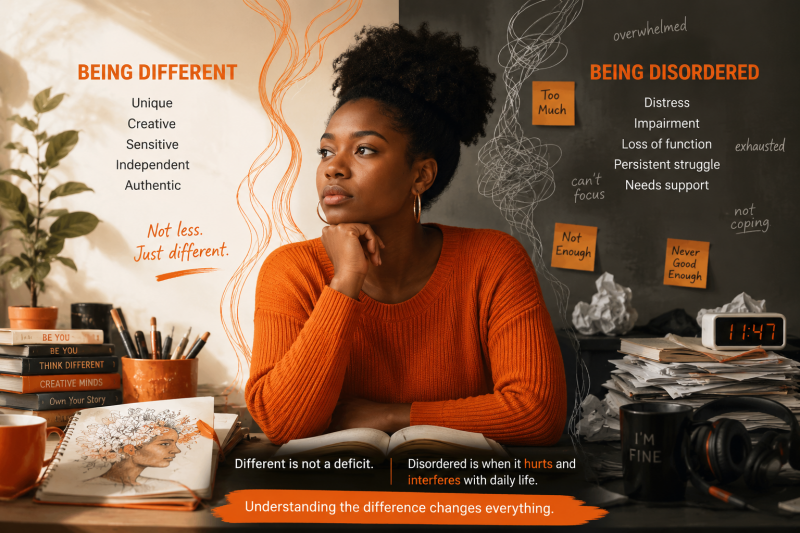
This is why the conversation around neurodivergent different not disordered matters.
Neurodivergence can involve real challenges. It can affect a person's ability to navigate work, education, relationships, communication, sensory environments, and daily life.
But experiencing the world differently does not automatically mean that a person is defective.
The distinction between difference and disorder is nuanced. Understanding that nuance can help us talk about neurodivergence in ways that acknowledge real struggles without reducing people to their difficulties.
Difference and Disorder Are Not the Same Thing
Neurodivergence is an umbrella term often used to describe variations in how people's brains process information, communicate, learn, experience emotions, regulate attention, and interact with the world.
Some neurodivergent people have formal diagnoses such as ADHD, autism, dyslexia, dyspraxia, or other neurodevelopmental conditions.
The word disorder is used in clinical settings for specific reasons. It can describe patterns of traits or experiences that significantly affect a person's functioning, development, or wellbeing.
However, clinical language is not always the same as identity language.
A diagnosis may help someone access treatment, accommodations, or support. But a diagnostic label does not describe the entirety of a person's identity, personality, abilities, creativity, relationships, or potential.
A person can experience significant challenges and still reject the idea that their entire existence is a problem to be fixed.
This is where the conversation becomes more complex than simply saying neurodivergence is either a disorder or not a disorder.
The Medical Model and the Social Model
One way to understand this difference is through two different ways of thinking about disability and difference.
The medical model
The medical model focuses primarily on the individual.
It asks:
- What condition is present?
- What symptoms are being experienced?
- How does this affect functioning?
- What treatment, intervention, or support may help?
This model can be useful.
It can help people access assessment, medication, therapy, accommodations, and other forms of support.
For someone experiencing severe executive functioning difficulties, sensory overload, emotional dysregulation, or challenges with daily living, professional support can make a significant difference.
The medical model can help identify those needs.
The social model
The social model asks a different question:
What barriers are society creating?
For example, a person who struggles to concentrate in a loud, open-plan office may be viewed as having a personal problem.
But what happens when that person is given access to a quieter workspace?
The challenge may not disappear completely, but the environment may become more accessible.
A person who struggles with verbal communication may be seen as deficient in a workplace that relies heavily on spontaneous meetings.
But what happens when they are given written instructions, agendas, and alternative ways to contribute?
A student who struggles to process information quickly may be labelled as incapable.
But what happens when they are given more processing time?
The social model reminds us that disability is often shaped by the interaction between a person's characteristics and the environment around them.
The same difference can be disabling in one environment and supported in another.
When Is Disorder Language Clinically Useful?
The word "disorder" can be uncomfortable for many people.
That discomfort is understandable.
Historically, medical language has often been used to stigmatize people who think, behave, communicate, or experience the world differently.
At the same time, completely rejecting clinical language can also create problems.
For some people, a formal diagnosis provides:
- Access to treatment
- Workplace or educational accommodations
- A better understanding of their needs
- Eligibility for certain services
- A framework for understanding persistent challenges
- Validation for experiences that have been misunderstood
In these contexts, clinical terminology can be useful.
A diagnosis can provide important information about a person's support needs.
The problem arises when a clinical label becomes a complete description of a person.
A diagnosis should not become shorthand for:
- Less capable
- Less intelligent
- Less valuable
- Less employable
- Less worthy of relationships
- Less capable of contributing to society
A clinical diagnosis can describe a condition.
It cannot define the full value of a human being.
When Disorder Language Becomes Harmful
Language becomes harmful when it turns difference into a moral judgment.
For example, describing someone as "disordered" because they need more time to process information can create shame.
Calling someone "broken" because they communicate differently can make them feel like they need to hide.
Assuming someone is less intelligent because they struggle with traditional academic systems can limit their opportunities.
The problem is not always the existence of clinical terminology.
The problem is how that terminology is used.
There is a difference between saying:
This person experiences challenges that may require support.
And saying:
This person is a problem.
Those are not the same message.
The first acknowledges a need.
The second attacks a person's identity.
Living Well With Difference
A person does not need to become indistinguishable from everyone else to live a meaningful life.
Sometimes, wellbeing comes from learning how to work with your brain instead of constantly fighting it.
That might mean:
- Finding environments that support your sensory needs
- Using systems that work with your executive functioning style
- Communicating your needs more clearly
- Creating routines that are flexible rather than rigid
- Taking breaks before reaching burnout
- Finding people who understand your communication style
- Asking for accommodations
- Building a career around your strengths
- Letting go of unnecessary expectations of normality
This does not mean that every challenge can be solved by changing the environment.
Some people experience significant difficulties that require medical, therapeutic, or practical support.
Being different does not mean struggling less.
It means we need to be careful about assuming that every difference is automatically a defect.
Community and Identity-First Language
Language is personal.
Some people prefer identity-first language, such as:
I am autistic.
Others prefer person-first language:
I am a person with autism.
Neither preference should automatically be imposed on everyone.
The most respectful approach is often to listen to how people describe themselves.
For many people, identity-first language is meaningful because neurodivergence is not something separate from who they are. It influences how they experience the world, communicate, relate to others, and understand themselves.
For others, person-first language feels more comfortable because they do not want a diagnosis or condition to become the primary way they are described.
There is room for both.
The goal should not be to create another rigid rule about how people must talk about themselves.
The goal is to give people agency over their own identities.
Difference Does Not Mean Denying Real Challenges
There is an important balance to maintain.
Saying that neurodivergent people are different, not defective, should not mean pretending that neurodivergence never creates real difficulties.
Many neurodivergent people experience:
- Burnout
- Sensory overload
- Executive functioning challenges
- Social exhaustion
- Anxiety
- Depression
- Difficulty accessing education or employment
- Discrimination
- Barriers to healthcare
- Challenges with independent living
These experiences are real.
Positive language should not become a way of dismissing people's pain.
A person can be proud of being neurodivergent and still need significant support.
A person can celebrate their differences and still wish certain challenges were easier.
A person can reject the idea that they are broken and still seek therapy, medication, accommodations, or other forms of help.
These things can coexist.
The Goal Is Nuance
The conversation around neurodivergence should move beyond two extremes.
One extreme says:
Neurodivergence is nothing but a problem.
The other says:
Neurodivergence never creates any difficulties.
Neither tells the whole story.
People are complex.
Neurodivergence can involve difference, disability, identity, challenge, creativity, limitation, strength, frustration, connection, and joy.
Sometimes, the same trait can be a strength in one environment and a challenge in another.
The goal is not to deny difficulty.
The goal is to stop treating difference as proof of lesser value.
A person can need support without being broken.
A person can have a diagnosis without being defined by it.
A person can experience disability without losing their dignity.
And a person can be different without needing to become someone else to deserve acceptance.
Understanding the difference between being different and being disordered helps create space for more honest conversations about neurodivergence.
Not every struggle should be dismissed.
Not every difference should be pathologized.
The answer is often found in the nuance.
Add comment
Comments