

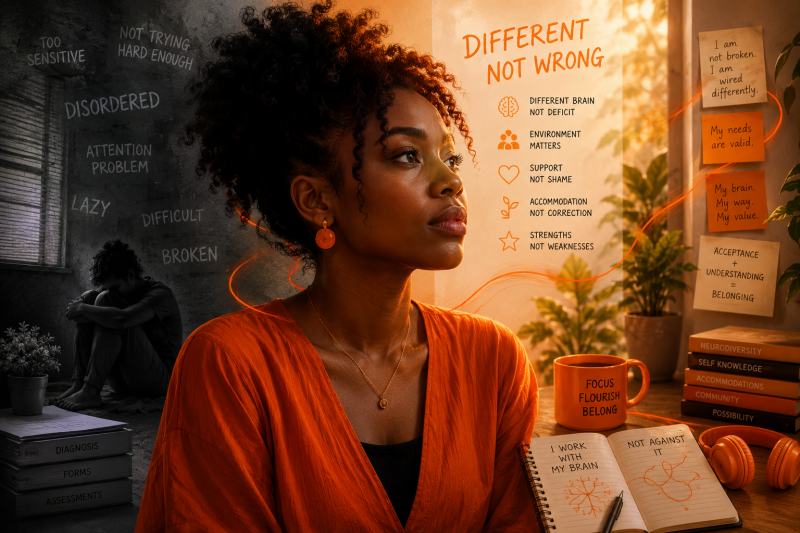
There's a sentence a lot of neurodivergent people hear at some point, usually meant kindly: "There's nothing wrong with you." It's meant to reassure. But it also reveals something: the question of whether something is "wrong" was on the table in the first place.
This is the heart of one of the most persistent tensions in how we talk about neurodivergence: is it a difference, or is it a disorder? The honest answer is that it depends on who's asking, why, and what they plan to do with the answer. Understanding that distinction, not flattening it into a slogan in either direction, is where real clarity starts.
Medical Model vs Social Model of Disability
Two frameworks shape almost every conversation about neurodivergence, whether people name them or not.
The medical model treats disability and neurodivergence as located inside the individual, a deviation from a biological norm that produces impairment. Under this model, autism, ADHD, dyslexia, and similar conditions are understood primarily as deficits to be diagnosed, managed, and where possible, corrected. The focus is on the person's brain or body as the site of the "problem."
The social model, by contrast, locates disability in the mismatch between a person and their environment. A wheelchair user isn't disabled by their legs; they're disabled by buildings without ramps. Applied to neurodivergence, this means an autistic person isn't inherently "impaired" by their wiring. They're disabled by classrooms, workplaces, and social norms built exclusively around neurotypical processing, communication, and sensory tolerance.
Neither model is entirely right or entirely wrong on its own. The medical model gives us diagnostic categories that unlock accommodations, funding, research, and treatment access, practical tools people genuinely need. The social model explains why so many neurodivergent people feel fine in one environment and completely overwhelmed in another, despite their brain not changing between the two. Most thoughtful clinicians and advocates today work somewhere between the two: using medical language where it's functionally useful, while recognizing that a great deal of neurodivergent suffering comes from environments, not from the neurodivergence itself.
Where "Disorder" Language Is Clinically Useful and Where It Isn't
"Disorder" isn't a neutral word, but it isn't a slur either. In clinical contexts, it does real work.
A diagnosis of Autism Spectrum Disorder or Attention Deficit/Hyperactivity Disorder is what unlocks access to therapy, medication, workplace accommodations, school support plans, and disability benefits in many countries, including across much of Africa's still developing disability infrastructure. Diagnostic language exists inside systems, insurance, education, law, that require a category to act on. Rejecting the word "disorder" outright can sometimes mean rejecting the paperwork that gets a child an Individualized Education Plan, or gets an adult protection from workplace discrimination.
Where the language becomes harmful is when it leaves the clinical file and starts shaping identity and self worth. A child who hears "disordered" repeated enough times, by teachers, relatives, or even well meaning specialists, can absorb it as a statement about their fundamental value, not a description of how their brain processes the world differently from a statistical majority. This is especially true in contexts where mental and neurological difference is still heavily stigmatized, and where "disorder" gets casually translated into local languages as something closer to "broken" or "cursed" than "different."
The useful distinction is this: disorder as diagnosis is a tool for accessing support. Disorder as identity is a trap that reduces a whole person to a deficit list. The word can serve one purpose without being allowed to colonize the other.
Living Well with Difference
None of this means neurodivergence is without real difficulty. Executive dysfunction is real. Sensory overwhelm is real. Rejection sensitivity, burnout, meltdowns, and the exhaustion of masking all day in spaces that weren't built with you in mind are not imagined, and pretending otherwise does nobody any favors.
But difficulty and disorder aren't the same thing. A left handed person writing with scissors built for right hands experiences real difficulty: smudged ink, cramped fingers, awkward angles. That difficulty says nothing about their hand being wrong. It says something about the scissors.
Living well with neurodivergent difference tends to involve a few consistent things: understanding your own patterns well enough to work with them instead of constantly fighting them, building or finding environments that reduce unnecessary friction, and having language for your needs that doesn't require framing yourself as broken to be taken seriously. This might look like noise cancelling headphones in an open plan office, body doubling to get through a task with executive dysfunction, or simply having a manager who understands that a blunt communication style isn't rudeness. None of these are "fixes" for a disorder. They're accommodations for a difference, the same way glasses accommodate different eyesight without anyone calling short sightedness a personality flaw.
Community and Identity First Language
Language choices in neurodivergent communities aren't just stylistic preferences. They carry real political and emotional weight.
Much of the autistic community, for instance, favors identity first language, "autistic person" rather than "person with autism." The reasoning is that autism isn't an accessory a person carries alongside their "real" self. It's a fundamental part of how they process and experience the world, inseparable from their identity. Person first language, while well intentioned and still preferred in some spaces, including many clinical and parent communities, can inadvertently suggest that the disability is something shameful that needs to be linguistically distanced from the person.
There's no single universally correct answer here. Different communities, generations, and individuals land differently, and the respectful move is usually to ask or follow the lead of the specific person or community you're engaging with, rather than assuming one convention applies everywhere.
What identity first language and the broader neurodiversity movement share is a rejection of the idea that there is one "correct" kind of brain, with every variation ranked as a lesser deviation from it. Instead, neurodivergence, autism, ADHD, dyslexia, dyspraxia, and more, is framed as part of natural human cognitive variation, similar to biodiversity in an ecosystem. Different doesn't mean deficient. It means different.
Encouraging Nuance, Not Dismissal of Real Challenges
The risk on one end is pathologizing every difference into a disorder needing correction. The risk on the other end is romanticizing neurodivergence so completely that real struggle gets dismissed, "everyone's a little ADHD" territory, where actual impairment gets waved away as quirky personality, and people who need support stop getting it because the language around their experience has been diluted into a personality trend.
Nuance means holding both truths at once: neurodivergence is a genuine, valid form of human difference, and some neurodivergent people experience real, significant impairment that deserves clinical attention, accommodation, and support, sometimes including diagnosis and treatment. Neither truth cancels the other out.
The goal isn't to argue neurodivergence out of the category of disability altogether, or to insist every neurodivergent person is thriving if only society would adjust. The goal is more modest and more honest: to stop assuming that "different" automatically means "wrong," while still taking seriously the challenges that come with navigating a world not built for every kind of mind. That's not a contradiction. It's just what nuance actually looks like.
Add comment
Comments